These artworks are multi-focal composites, often created from several hundred individual photographic frames, all evocatively brought together to produce prints of incredible clarity and depth.
All prints are Giclée printed on 308gsm Hahnemühle archival paper, with 12 colour UltraChrome Pro pigments, to give perfect renditions of the original artefacts.
If you don’t see the particular artefact that you are interested in, please contact me directly to check availability.
“Fine art is that in which the hand, the head, and the heart of man go together.”
John Ruskin.
In 1972, Lady Virginia “Ginny” Fiennes drew a red crayon line around an old 6-inch tin globe from her school days to plot a route from London, over the North Pole, down to the South Pole, and back, aiming to circumnavigate the world along its vertical axis. This became the blueprint for the successful Transglobe expedition, 1979-’82. She was the first woman to receive the Polar Medal.
Printed on Hahnemühle archival 308gsm Photorag paper.
An early rebreather belonging to Hans Hass that allowed him to “swim like a fish, not walk like a man on the ocean floor”. Developed in conjunction with German valve manufacturer Drager, the rebreather was revolutionary, and Hans and his wife Lotte spent the rest of their lives promoting diving through his pioneering books and films.
Printed on Hahnemühle archival 308gsm Photorag paper.
One of Nims Purja’s ice axes, from when he set a world record by summiting all 14 of the world’s 8,000-meter "death zone" peaks in just 6 months and 6 days in 2019, shattering the previous record of 7 years.
Printed on Hahnemühle archival 308gsm Photorag paper.
This small black rectangle of cloth, was the first thing Scott and his men saw in a white and frozen world to know that they had been beaten to the South Pole. Left by Amundsen to mark a supply dump of food and letters to corroborate his victory, it sent a knife of despair and dissolution through their hearts.
Printed on Hahnemühle archival 308gsm Photorag paper.
In 1989, British Explorer Wally Herbert concluded from Peary’s documentation that Peary and Henson had probably stopped seven miles short of the North Pole in April 1909. It turns out that the next explorer to have surface traversed across the ice successfully to the North Pole, was a former insurance salesman with no previous polar exploration experience called Ralph Plaisted. He reached the pole with his three colleagues at 10:30am on April the 19th, 1968.
Printed on Hahnemühle archival 308gsm Photorag paper.
Climbing Crampons used by Howard Somervell, who was part of the 1924 expedition to Everest. A devout Christian he was also a surgeon, an artist and missionary who, after his two Everest Expeditions, spent 40 years working as a doctor in India.
Printed on Hahnemühle archival 308gsm Photorag paper.
A Hindi language print of George Lowe’s film “The Conquest of Everest”, filmed by Tom Stobart, with aerial photography by the Indian Air Force; 1953.
Printed on Hahnemühle archival 308gsm Photorag paper.
Mountaineering goggles belonging to Howard Somervell, who was part of the 1924 expedition to Everest, where, with Edward Norton, climbed to an altitude of 8570m, a record which would not be broken, with certainty, until 1952.
Click here for print availability.
-
Printed on Hahnemühle archival 308gsm Photorag paper.
The ship’s bell of the Terra Nova, the ship that delivered Robert Falcon Scott and his team on his fateful expedition to the South Pole in 1910. The bell resides at the Scott Polar Research Institute and is still rung daily for tea time at 11am and 4pm.
Click here for print availability.
-
Printed on Hahnemühle archival 308gsm Photorag paper.
On 15 October 1997, 50 years and 1 day after the sound barrier was broken in aerial flight by Chuck Yeager, Wing Commander Andy Green reached 763.035 mph (1,227.986 kmph) in his car ThrustSSC, in Black Rock Desert, Nevada, the first ever supersonic land speed record (Mach 1.016).
Click here for print availability.
-
Printed on Hahnemühle archival 308gsm Photorag paper.
During the crash that destroyed Bluebird K7 and took Donald Campbell’s life, the “infinity” insignia from the side of the pontoon was ripped from the side of the pontoon.
Click here for print availability.
-
Printed on Hahnemühle archival 308gsm Photorag paper.
Moments before four minutes past six, on the evening of the 6th of May 1954, Roger Bannister crossed the finish line at Iffley Road Track in Oxford, setting a new World record and breaking the four minute mile. As the announcer read out the time, the crowd erupted as soon as they heard three, and the time keeper holding the stop watch above dropped it, shattering its glass and freezing the record time forever. It would be several minutes before Bannister heard his actual time, a time that up till then had been considered impossible.
Printed on Hahnemühle archival 308gsm Photorag paper.
A signed Arctic Mitt from 1909, belonging to Matthew Henson, who accompanied Robert Peary on expeditions for over 18 years. It became clear that Henson and not Peary had actually walked over the North Pole first, leading to Peary completely claiming the achievement for himself with no acknowledgement of Henson.
Printed on Hahnemühle archival 308gsm Photorag paper.
Mensun Bound’s Siebe Gorman & Co non-magnetic diver’s knife, with a dive computer developed by Hans Haas and given to Mensun to test, and was worn by his wife and fellow diver Jo Yellowlees-Bound.
Printed on Hahnemühle archival 308gsm Photorag paper.
A piece of wreckage torn from Donald Campbell’s land speed record car, Bluebird CN7, after it was badly damaged at Bonneville Salt Flats crashing at over 360 mph. The car could accelerate from 0-400 mph in 24 seconds. Having been completely rebuilt, Campbell went on to break the land speed record on Lake Eyre, peaking at 440 mph.
Printed on Hahnemühle archival 308gsm Photorag paper.
John Deane’s original prototype for the first ever diving helmet, converted from his and his brother’s design for an anti smoke inhalation device. 1826.
Printed on Hahnemühle archival 308gsm Photorag paper.
Sir Ranulph Twisleton-Wykeham-Fiennes, 3rd Baronet OBE, known as Ran to his friends, is the only man to have been awarded the Polar medal and double clasp, for expeditions to both Poles twice. He is often referred to as the greatest living explorer.
Printed on Hahnemühle archival 308gsm Photorag paper.
Bull whip carried by Roy Chapman Andrews, Director of the American Museum of Natural History, believed to be the inspiration for Indiana Jones. He was the first to discover definitive proof that dinosaurs gave birth to eggs and not live young.
Printed on Hahnemühle archival 308gsm Photorag paper.
Breathing equipment from the 1953 British Mount Everest Expedition, developed in conjunction with German valve manufacturer Drager.
Printed on Hahnemühle archival 308gsm Photorag paper.
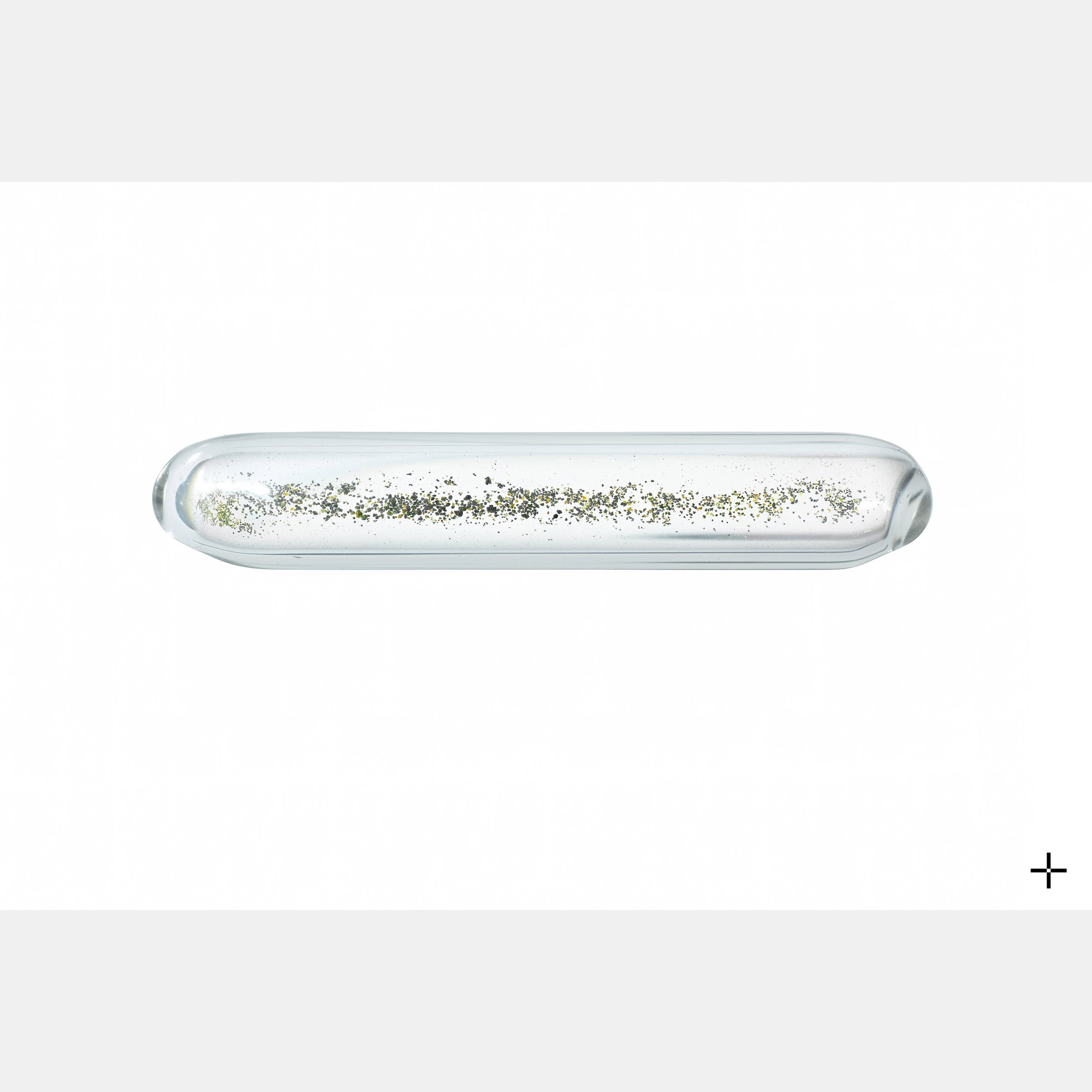
A 3 milligram vial of Moon dust, collected by Neil Armstrong on Apollo 11, 1969.
Printed on Hahnemühle archival 308gsm Photorag paper.
The front page of The New York Times the day after Neil Armstrong and Buzz Aldrin walked on the surface of the moon with Apollo 11.
Printed on Hahnemühle archival 308gsm Photorag paper.
On the morning of January 4, 1967, Donald Campbell made his attempt to break 300mph on water. His first run made 297 mph, and on the return run, Bluebird K7 entered the measured kilometre at 328.12mph; shortly afterwards he crashed and perished. This glove, recovered in 1997, is testament to the violence of the shattering impact of the crash. Campbell is the only person to hold speed records for both land and water in the same year, 1964.
Printed on Hahnemühle archival 308gsm Photorag paper.